
When starlings, house sparrows, or other nuisance birds move into your attic, vents, soffits, or chimney, Critter Removal Indianapolis gets them out humanely – and seals the openings so they cannot come back.
Our exclusion-first approach to bird removal in Indianapolis does not just clear the birds; it finds exactly how they got in and closes every entry point
Our professional bird control and removal services cover every step, from initial inspection, humane removal, exclusion, and cleanup. It’s the kind of bird control and removal Indianapolis families rely on, and we handle jobs as small as one starling in a vent or as large as a full attic infestation.
Locally Owned
Indiana DNR Certified
BBB A+ rated
Available 24/7
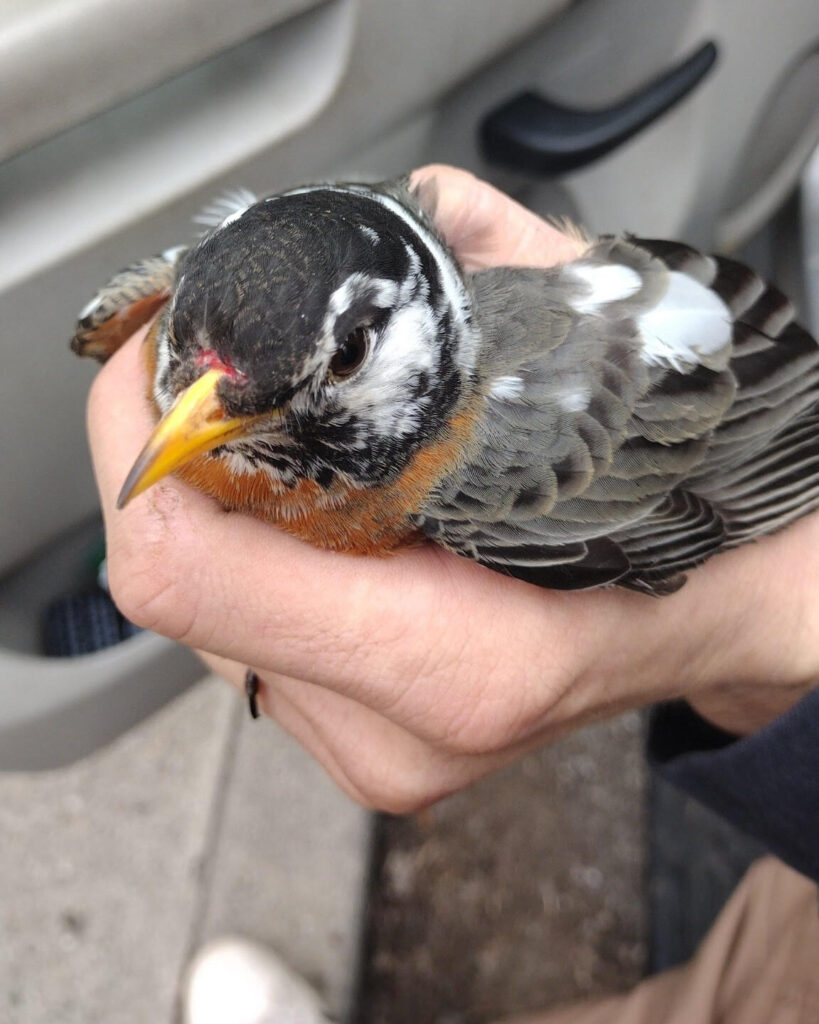
With birds, it almost always comes down to noise. Starlings are especially loud, and flapping against a metal gutter, vent, or chimney cap can reverberate through the house – so the first job is telling whether a bird is actually inside or simply active on the exterior.
Here’s what tips off most Indianapolis homeowners:
You will hear flapping, scratching, and chirping, mainly at night, but often during the day. Inside a wall, vent, or duct the sound travels and can seem much louder than the bird actually is.
If a nest with fledglings is built inside a dryer vent or soffit, you will hear constant chirping and fluttering. Fledglings are very loud, and that noise is a strong sign birds are nesting inside – not just perching.
Droppings building up below a vent, ledge, soffit, or gutter line often mark the exact spot where birds are entering and roosting.
A single bird on the roof once is not an infestation. But if birds come and go from the same gap every day over several days, they are likely nesting inside.
“Birds are opportunists. They’re not going to tear into the home like other wildlife – they’re just going to use what’s already naturally there, whether that’s a gap on the home or an open, compromised space that lets them feel the airflow from the attic.”
Every bird job starts with a full inspection, from top to bottom. Because birds can be protected and can have active nests, we build the timeline around what we actually find in your home.
We inspect the entire exterior, including gable vents, attic vents, chimneys, roof line, dormers, and eaves, to find every opening. If one vent is open, the rest of the house is usually the same, so we map all of them.
We confirm which bird we are dealing with and whether there’s an active nest with eggs or fledglings. That determines what we can legally do and when we begin.
We remove the birds and seal the entry points. We do not just close one opening – we seal gable vents, chimneys, roof lines, dormers, and eaves together so birds cannot simply move to the next gap around the house.
We install vent covers and chimney caps to keep birds out for good. On tall or complex chimneys this can require two or more technicians, careful ladder placement, and harnesses tied to the ridge line so the work is done safely.
We clean nesting and droppings, and when persistent birds keep landing on the home, we add deterrents – always in conjunction with exclusion, never as a standalone guarantee.
⚠️ Timeline: Most bird jobs wrap in about two weeks, but if there’s an active nest we have to let fledge, it can take up to a month. Fledglings need up to roughly three weeks to be old enough to leave the nest with the mother before we can remove the nest.
Sealing a home against birds is not the same as excluding mammals like raccoons or squirrels. Two factors make bird work its own discipline: certain birds are legally protected, and birds nest on a tight seasonal calendar.
If there are eggs or fledglings in a nest, we must wait, which shapes the entire timeline and when we can start. And unlike a ground-level mammal job, birds often lead us to the very top of a tall chimney or roof line, which adds real safety complexity for this type of exclusion job.
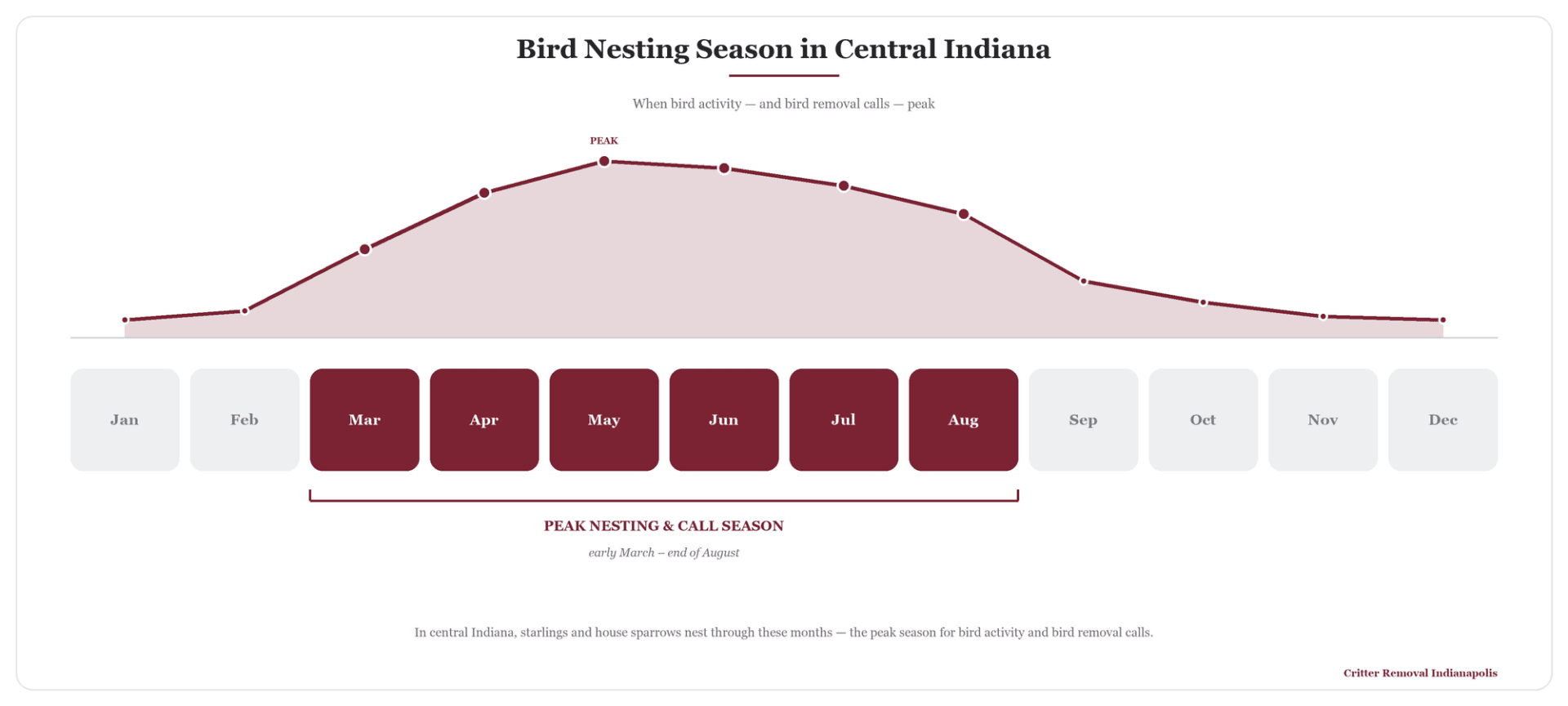
In central Indiana, bird nesting season runs roughly from early March through the end of August. During those months, starlings and house sparrows hunt for a protected place to build a nest and raise a clutch of eggs, and the natural gaps around your roof line, vents, and chimneys are exactly what they’re after.
⚠️ Key Insight: Some birds raise multiple clutches of fledglings in a single season, so a small opening left unsealed in the spring can become a recurring problem by midsummer.
When a protected or migratory bird is involved, we cannot simply begin exclusion work right away. We have to secure special authorization first. With geese, for example, we have had to bring in the U.S. Fish and Wildlife Service members, file a report, and get approval before excluding. We will discuss the exclusion capabilities with you, so you remain up to date on the whole project.
Just as common are bird mites – the nesting material birds leave behind in an attic is usually full of tiny bugs and mites that can spread into the living space. It’s one of the main reasons you do not want an old nest sitting in your home.
The damage adds up outside, too. Bird droppings are acidic and eat away at paint, deck staining, and finishes, while nesting material packs into vents and equipment. We have removed a single bird’s nest more than six feet tall from an attic, and seen nesting ruin wiring and mechanical awnings. When it’s time to clear it out, our attic cleanup team handles bird nesting removal, droppings cleanup, and full disinfection of the space.
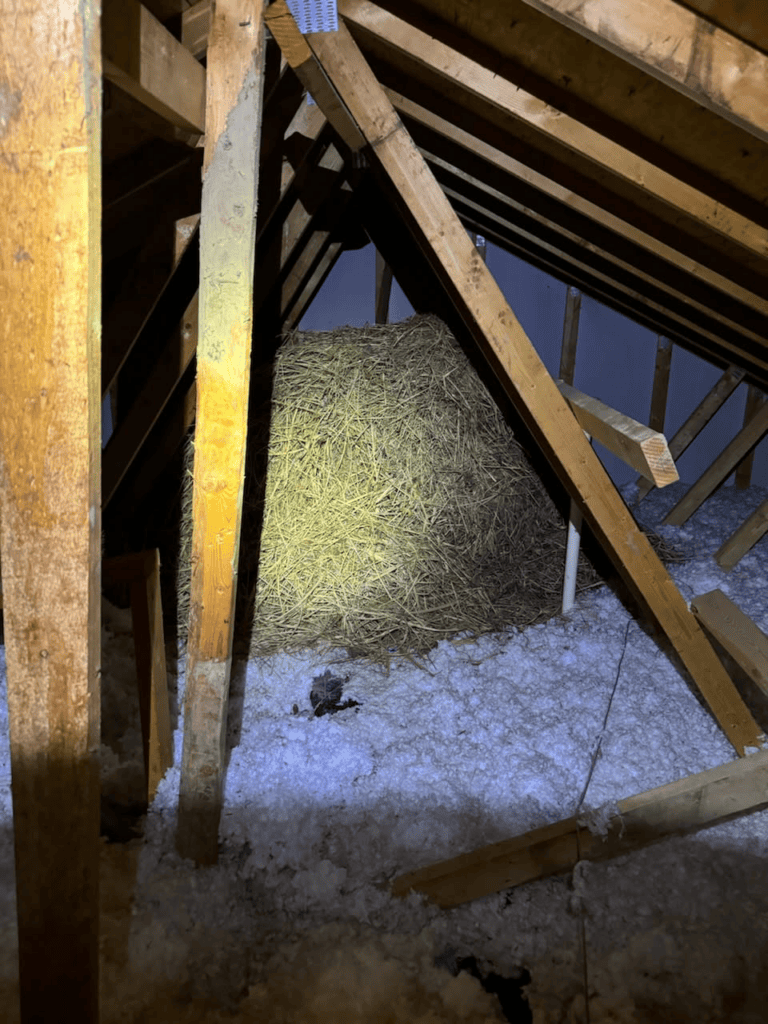
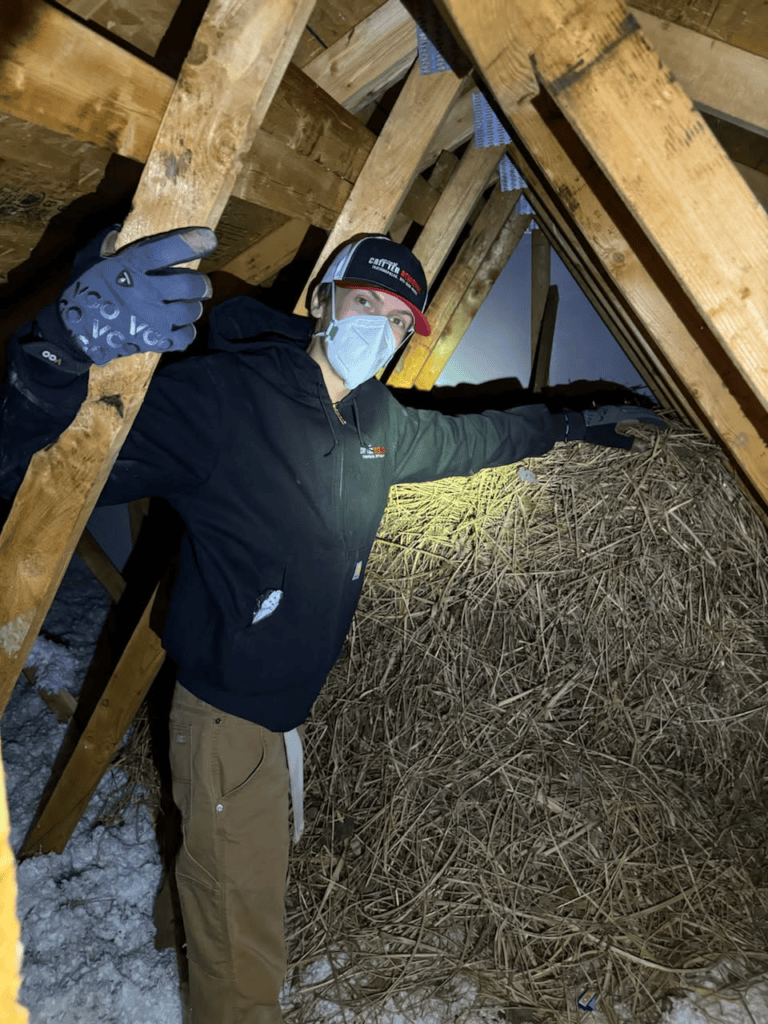
The largest bird’s nest our team has ever removed from an Indianapolis attic – shown with a Critter Removal technician for scale.
No two bird jobs are the same, and the price depends entirely on what we find during the inspection. A single accessible vent is straightforward. A nest at the top of a 40-foot chimney, an active protected species, or nesting packed deep inside ductwork is a different project altogether.
The main factors that shape your quote:
For a detailed breakdown of what bird removal typically runs in the Indianapolis area, see our guide on how much bird removal costs.
We stand behind our work with a guarantee for a fixed price. No hidden fees or surprises.
A few reasons homeowners choose our bird control services over a national call center:
Instead of only removing the bird, we find exactly how it got in, use humane exclusion, and fully seal every entry point.
Our whole-house coverage means bird-proofing your home so you’re not calling us back every season.
We are a genuinely local, family-owned Indianapolis company serving the area since 2018, not a national call center.
We’re Indiana DNR licensed and BBB A+ rated, and reachable around the clock. In true health or safety situations, we follow all Indiana regulations to protect your family and home.
Birds are not only a home problem. Warehouses, hospitals, retail spaces, and multiunit buildings all need commercial bird control Indianapolis property managers can rely on. Starlings, pigeons, and sparrows roost on ledges and nest in vents and rooflines just as readily on a commercial building as on a house.
Our commercial bird control in Indianapolis follows the same exclusion-first approach – identify the openings, seal them, and add deterrents where birds persist.
Commercial and HOA-governed properties can also be more involved. It’s a good example of why we inspect thoroughly before quoting commercial work. The scope is rarely what it looks like from the ground.
For businesses managing insects alongside birds, we also offer commercial pest control.
Critter Removal Indianapolis provides bird removal services and humane exclusion throughout greater Indianapolis and the surrounding communities, including Fishers, Carmel, Noblesville, Zionsville, and Westfield. We serve Marion, Hamilton, Boone, Hendricks, Hancock, and Johnson Counties, and we are a truly local, Indiana DNR licensed team just up the road.



Starlings and house sparrows are the two we most often find getting into attics. Pigeons are usually more of an exterior nuisance, perching on the outside of the home rather than getting in. Woodpeckers we do see, but more because they create holes that squirrels later use. Because starlings are our most common intruder, our starling removal services are a core part of what we do.
Removals take about two weeks in most cases. If there’s an active nest we have to let fledge, it can take up to a month, since fledglings need up to roughly three weeks to be old enough to leave with the mother.
No. Starlings, pigeons, and house sparrows are common and are not federally protected. Native birds – birds of prey, woodpeckers, chimney swifts, songbirds, and waterfowl – are protected and require special authorization before any exclusion work.
Certain birds are legally protected, and birds nest on a seasonal calendar, so an active nest can mean we have to wait. Birds also tend to nest at dangerous heights, which adds safety complexity that a ground-level mammal job does not.
Yes. We seal gable vents, attic vents, chimneys, dormers, eaves, and roof lines, and install caps and covers to keep birds out for good – sealing all openings together so birds cannot just move to the next one.
Monitor it. Sometimes the noise is only on the exterior, where there is a limit to what we can do. But if it’s the same spot every day over several days, there’s likely something inside and it’s worth an inspection.
Yes. Histoplasmosis from accumulated droppings and bird mites in nesting material are the main concerns, along with acidic droppings that damage the exterior of your home over time.Waiting too long. A raccoon finding a winter den in November becomes a mom with babies by spring — and by then the insulation damage, droppings, and entry point deterioration have all gotten worse. The other big one is DIY. People try everything they read online, and then they call us. If they’d called us first, it would’ve been a simpler and cheaper job.
Yes, but in conjunction with exclusion. Because every home and bird situation is different, we cannot guarantee a deterrent alone will keep birds away, so we pair deterrents with sealing entry points. For insect issues, we also handle pest control.
If you’re hearing flapping in a vent or watching birds slip into your soffit, don’t wait for the nest – and the damage – to grow.
Call Critter Removal Indianapolis for humane bird removal and full exclusion, backed by our satisfaction guarantee.
AVAILABLE 24/7 • NO HIDDEN FEES